

Two years ago we entered lockdown, as the UK grappled with Covid-19. It was an unprecedented moment. Worldwide, lockdowns often had horrific consequences for each country’s most vulnerable citizens. What could a small charity like Global Care do in the face of a worldwide crisis?
Despite all our experience in delivering emergency aid, this was a moment like no other. Marginalised communities supported by Global Care’s international partners entered a period of intense crisis – simultaneously. Suddenly, almost ALL the communities in which we work needed help, fast.
Everywhere, people were hungry. And everywhere, schools were closed, leaving children stuck in tiny shacks for days on end, or left to roam. Unsupervised, hungry, often desperate; risk factors for child exploitation and abuse instantly multiplied.
Back in the UK, even amidst the uncertainties of our own situation, we knew we had to act. The stories coming in from partners everywhere were harrowing.
What happened?
Since that decision to act, two years ago, Global Care has raised a total of £199,904 to fund our coronavirus response. Our donors have supported us magnificently. Thank you!
You have directly helped an estimated 19,459 people, including over 13,000 extremely vulnerable children, and improved hygiene for a further 24,000 people.
 Where did the money go?
 Where did the money go?
Over half the funds (55.6%) were spent on feeding programmes for hungry families facing starvation in multiple lockdowns. Like Vinod and Priya in India, or Gordon in Kenya and Immaculate in Uganda.
Another third (36.2%) was spent on initiatives supporting learning. As the world pivoted to online classes, most of our families were locked out of education. Without access to devices or unable to afford data, with no quiet space in which to learn, and without support from often illiterate parents, the learning of millions of children went into reverse.
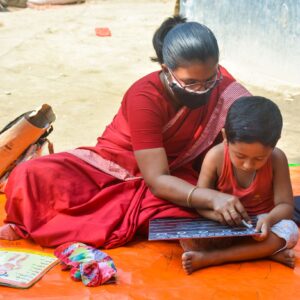 Our grassroots partners were not prepared to stand by and watch that happen. They know, better than anyone, the fundamental role of education in breaking the poverty cycle and building better futures for marginalised families.
In Bangladesh, teachers offered mobile tutoring for children like Amrito, while the team in Guatemala opened a study centre for high-risk children like Miguel. In Zimbabwe and Albania our partners ran catch-up classes and in Zambia a summer school for exam students. In Uganda and India, they delivered study packs to students’ homes. The efforts of these grassroots groups have played a major role in helping hundreds of marginalised children access learning and prevent school drop out.
Thanks to the generosity of UK donors, Global Care was able to fund it all.
CEO John White says: “Covid has had catastrophic effects on the lives of millions. In the face of such enormous need it’s easy to be overwhelmed and I am so proud of our partners, small grassroots groups themselves, who sprang into action right at the beginning and never stopped working. They have magnificently served the needs of the communities they support. It has been a privilege to stand alongside them.”
So what’s next?
“Sadly, we know it’s not over yet,” says John. “Rebuilding after Covid will take years, and will be harder still in the context of increasing conflict and financial instability. We will continue to support initiatives which help children back into learning, and support children to catch up on all they missed.
“Looking back, our long-standing motto has never been more apt: Can’t do everything, mustn’t do nothing. we can always do something!”
All our coronavirus response work is funded through our Children At Risk programme. If you would like to give to help our on-going work to rebuild after Covid, please join us.
I want to help