

Prefer to listen to this page?
Of the 168.9 million people in Bangladesh, about 20% live below the poverty line. The impoverished populations of Bangladesh are extremely vulnerable to changing weather conditions, living on the low-lying delta region. Regular flooding and storm-force winds threaten people, livestock, crops and livelihoods – conditions which have increased in frequency and severity with climate change.
Literacy rates are low and education difficult to access for the communities we work amongst. The majority of people here eke out a grinding existence as day labourers, fishermen, landless farmers, tricycle pullers, boatmen and small traders.
We work in the community of Horintana. Bisected by the Kazibacha River, the area is prone to flooding and both transport and communication are difficult. The nearest city is the river port of Khulna.
What are the challenges?
These impoverished communities have a low appreciation of the importance of education. With 50% of girls married by the time they’re 18 – and 15% before they’re 16 – this is a community driven by survival.
Malnutrition, poor health, poor sanitation, a lack of safe, clean drinking water and few accessible healthcare facilities are all challenges families struggle to overcome.
*Dan’s father lost his home and land due to river erosion just before Dan was born. The family constantly struggled for food. Then, over just a few years, his mother and father died, leaving Dan with his grandparents, and an uncle in distant village.
When he was six, Dan’s grandmother was diagnosed with cancer, and approached our Bangladeshi partners, Love Your Neighbour, to request a place at the Home of Love. When the team visited they found little food in the house, and a very dirty, thin little boy. They welcomed him in, and Global Care found him a sponsor.
Now aged eight, during a recent visit to the village, neighbours were amazed at Dan’s transformation. Sponsorship has given him a bright future. Read Dan’s full story…
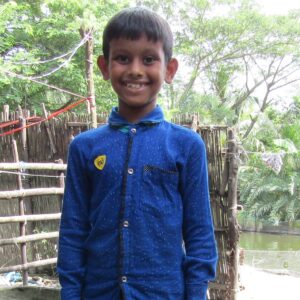 *Dan’s father lost his home and land due to river erosion just before Dan was born. The family constantly struggled for food. Then, over just a few years, his mother and father died, leaving Dan with his grandparents, and an uncle in distant village.
How is Global Care tackling poverty in Bangladesh?
We have centres in Horintana, Kalatala and Dacope Union. All three are cyclone-proof buildings which double as pre-schools and community centres, in disadvantaged rural communities. While an estimated 21% of children drop out of school before completing primary education in Bangladesh, the drop out rate for children who have attended one of our partners’ pre-schools is just 2%.
In Horintana we also care for up to 30 orphaned and abandoned boys at the Home of Love. Historically, some children were brought to the home by families unable to afford their care – so-called ‘economic orphans’. We’re working with our partners to keep those at risk of becoming economic orphans with their families through our Keeping Families Together programme. We continue to support and care for children who are orphaned, abandoned or unsafe with their families of origin at the Home of Love.
We encourage self-sufficiency at the project and empower local families to develop sustainable incomes. Initiatives include: paddy fields, a chicken egg farm, fish lake, a goat scheme, micro-finance project for local enterprises, growing water melon and other fresh produce.
How can I help fight poverty in Bangladesh?
Could you sponsor a boy in the Home of Love? We have seen over many years how sponsorship transforms young lives, helping a vulnerable child grow into a strong adult, through consistently meeting health, welfare and education needs. Be part of a child’s journey today!
I want to help